
You’ve invested in your location. You’ve built a product worth selling. But when customers walk past your door, they don’t stop. Not because your offer is weak — but because nothing told them to look. That’s the problem LED display solutions are built to solve. Not with louder colours or bigger fonts — but with dynamic, always-on visual communication that makes your business impossible to ignore, day or night.
That’s the real problem most businesses overlook. Visibility isn’t about luck or foot traffic numbers. It’s about signal clarity: the ability to communicate something compelling, fast, and without a word of explanation needed.
LED display solutions are one of the most effective tools available today for solving exactly that. In this guide, you’ll learn what LED displays actually do, which types fit which environments, and how to make a smart decision before investing — whether you’re running a retail store, a corporate office, a hotel, or a restaurant.
What LED Display Solutions Actually Do (That Static Signs Can’t)
Most signage is a one-way broadcast. You print something, you mount it, and it stays there until it fades or becomes irrelevant.
LED displays break that model entirely.
A professional LED display solution lets you control your message in real time. You can push a promotional video in the morning, a menu update at lunch, and a brand awareness loop in the evening — all from a single device, without touching the physical sign.
The result isn’t just aesthetic. Research consistently shows that dynamic digital displays generate significantly higher brand recall than static alternatives — with some studies reporting up to 83% better recognition. Customers notice movement. Their eyes are wired for it.
Beyond attention, LED displays offer something static signs never can: relevance on demand. The ability to change your message based on time, season, promotion, or audience — without reprinting, without reinstalling, without extra cost per update.
For businesses that compete on visibility, that flexibility is not a luxury. It’s a structural advantage.
The 4 Types of LED Display Solutions — and Which One Fits Your Space
Not every LED display is the same. The right choice depends entirely on where the display lives and what it needs to communicate. At Vizal, we work with four core solutions, each engineered for a specific environment.
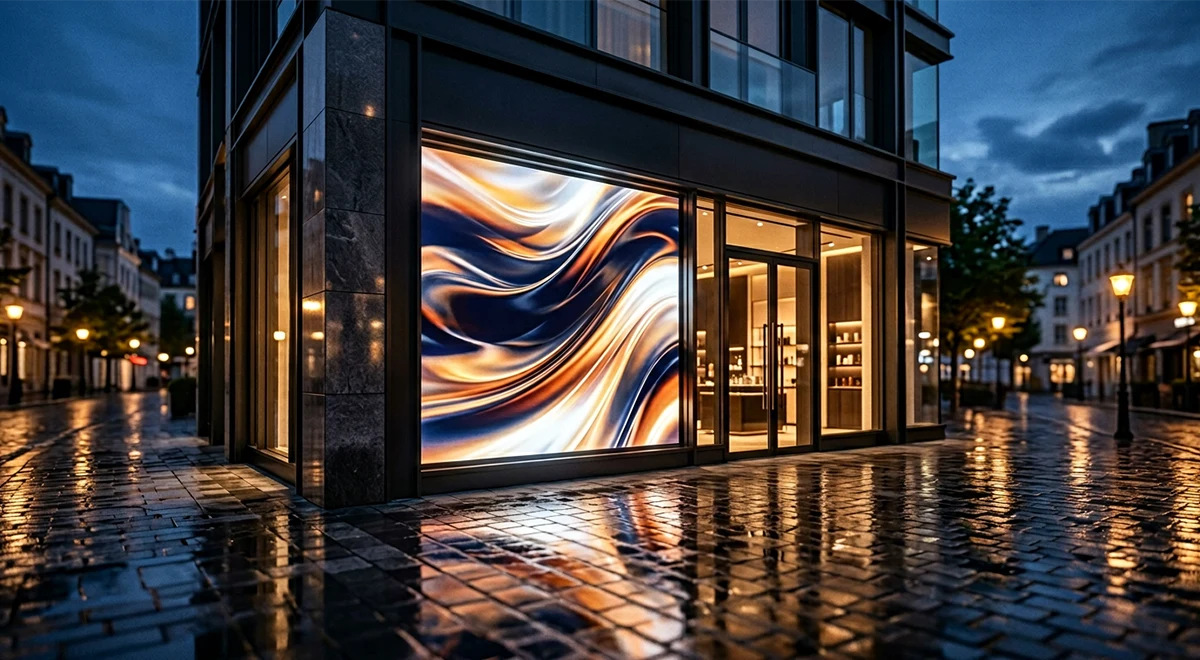
Window LED Displays — Turn Your Storefront Into a 24/7 Ad
If your business has street-facing windows, you’re sitting on prime advertising real estate that most brands leave completely unused.
Window LED solutions are designed to be visible from the outside — high-brightness screens engineered to cut through daylight, rain, and direct sunlight. They’re used by retail stores, banks, pharmacies, and hospitality venues to capture foot traffic before it walks past.
The logic is simple: someone who notices your window display has already been converted from a passerby into a potential customer. That moment of attention is worth more than almost any other marketing touchpoint — and it happens without a click, without an ad budget, without an algorithm.
Wall LED Displays — Transform Interior Spaces Into Brand Experiences
Inside your space, LED wall solutions serve a completely different purpose. They’re not about capturing attention from the street — they’re about controlling the narrative once someone is already inside.
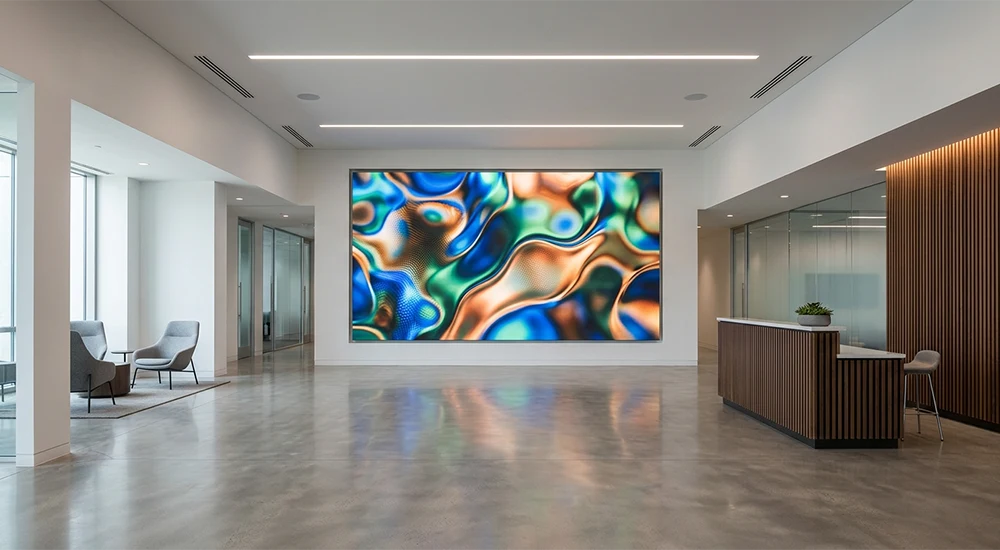
A well-placed wall display in a lobby, showroom, restaurant, or gym communicates brand authority instantly. It replaces printed banners, framed posters, and outdated TV screens with a single high-resolution surface that you fully control.
Corporate offices use them to display live data dashboards, company values, and welcome messages. Retail brands use them for promotional content and product showcases. HoReCa venues use them for menus, atmosphere, and event announcements.
Wall displays are also one of the strongest signals of brand seriousness. Clients, visitors, and partners notice them — and draw conclusions about the quality of the business behind them.
Stand-Alone LED Displays — Flexible Signage That Goes Where You Need It
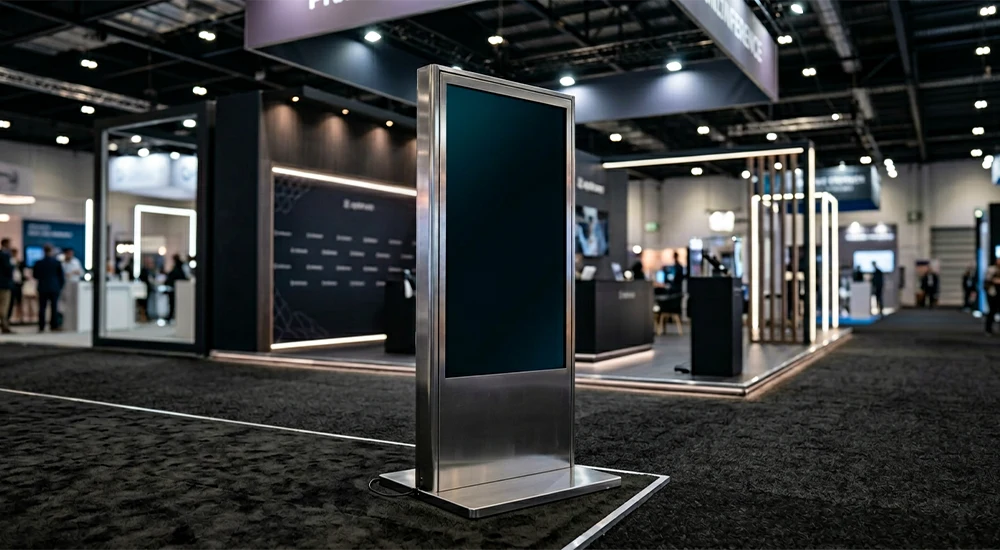
Not every space allows for wall mounting or permanent installation. Stand-alone LED solutions are freestanding displays — mobile, modular, and easy to reposition.
They’re ideal for trade shows and exhibitions, retail floor promotions, brand activations, events, and temporary campaign spaces. The display moves with the campaign instead of staying fixed in one location.
For businesses that operate across multiple locations, or that need a high-impact presence at events, stand-alone LED solutions offer the same visual quality as permanent installations — with full flexibility in placement.
Desk LED Displays — Small Format, High Impact at the Point of Decision
Size doesn’t determine impact when placement is right.
Desk LED displays are compact screens designed for reception areas, checkout counters, consultation desks, and any space where a customer is stationary for more than a few seconds. That moment of waiting — while a transaction processes, while a form is being filled, while someone is being greeted — is one of the highest-attention windows a business has.
A desk display in the right position communicates upsell opportunities, brand messaging, safety information, or service promotions directly at the point of decision. It’s subtle, professional, and consistently effective for businesses that understand that every customer touchpoint is an opportunity.
Why More Businesses Are Switching to LED Display Solutions in 2025
The shift is accelerating. Digital signage adoption has grown steadily across retail, hospitality, healthcare, and corporate sectors — and the reason isn’t trend-chasing. It’s economics.
Lower cost per message. Every time a static sign needs updating — new promotion, new season, new pricing — it costs money to reprint, reinstall, and discard the old material. An LED display eliminates that cycle entirely. The investment is front-loaded; the ongoing cost is close to zero.
Energy efficiency. Modern LED technology consumes significantly less power than older display systems, making large-format screens viable even for businesses with strict energy budgets.
Durability. Professional LED displays are built for continuous operation — 24 hours a day, 7 days a week. The technology is engineered for commercial-grade environments, not consumer use.
Visibility range. High-luminosity LED screens are readable in direct sunlight and at significant distances. A window display that catches attention from 30 meters away is doing work that no printed sign can replicate.
For businesses that take brand visibility seriously, the question is no longer whether LED display solutions make sense. The question is which type, and where.
What to Look for Before You Invest in an LED Display
Making the right choice requires asking the right questions upfront. Before committing to any solution, consider these four criteria:
Pixel pitch. Pixel pitch defines the distance between individual LED points and determines viewing quality at close range. Lower pitch = higher resolution, ideal for indoor displays viewed from a short distance. Higher pitch works well for outdoor or large-format screens seen from further away.
Brightness (nits). Indoor displays typically require 800–1,500 nits. Outdoor and window-facing displays need 3,000–8,500 nits to remain visible in daylight. Under-spec a display for its environment and you’ve wasted the investment.
Content management. The display is hardware. The content system is what makes it valuable. Ensure the solution includes an intuitive content management platform — ideally one that allows remote updates, scheduling, and multi-screen control.
Installation environment. Wall thickness, power access, mounting surface, viewing angles, and ambient light all affect which product fits. A trusted supplier should assess the space before recommending a solution, not after.
At Vizal, every LED display project starts with a site and brief assessment — because a display that isn’t specified correctly for its environment won’t perform. And a display that doesn’t perform isn’t an investment. It’s a cost.
Real Applications: How Brands Are Using LED Displays Right Now
LED display solutions aren’t theoretical. They’re already working in environments across industries:
Retail — chains use window LED displays to announce promotions and draw customers off the street, replacing seasonal print campaigns with real-time digital content.
HoReCa — restaurants and hotels use wall-mounted LED screens to display menus, events, and brand content, reducing print costs while improving the customer experience.
Corporate — offices use large-format wall displays in lobbies and meeting rooms to communicate brand identity, display live data, and elevate the perception of the business for clients and partners.
Real estate and banking — window-facing LED solutions showcase property listings, rates, and offers with dynamic content that static window cards can’t match.
Events and exhibitions — stand-alone displays give brands a premium visual presence at trade shows without permanent installation requirements.
Vizal has delivered LED display solutions for clients across Romania and Europe — including projects for retail chains, media agencies, fast food venues, coffee shops, and real estate offices in France and the UK. The full portfolio is available to browse.
Frequently Asked Questions
How much does an LED display solution cost?
Pricing varies significantly based on screen size, pixel pitch, brightness requirements, content management system, and installation complexity. Compact desk displays start at a few hundred euros, while large-format indoor or outdoor installations range into several thousand. The more important question is cost-per-impression over the display’s lifetime — which typically makes LED a more efficient investment than recurring print or traditional signage.
Can LED displays be used outdoors?
Yes — with the right specification. Outdoor LED displays require higher brightness ratings (typically 5,000+ nits), weatherproofing (IP65 or higher), and robust mounting systems. Vizal’s outdoor signage solutions include LED pixel displays engineered for exterior environments.
How difficult is it to update content on an LED display?
Modern LED display systems include cloud-based content management platforms that allow you to update screens remotely, schedule content in advance, and manage multiple displays from a single dashboard. No technical expertise is required for day-to-day content changes.
How long do LED displays last?
Commercial-grade LED displays are rated for 50,000–100,000 hours of operation, which translates to 10–15 years of continuous use under normal conditions. Most quality LED solutions also come with a manufacturer’s warranty and post-installation support.
Do I need planning permission to install an LED display?
Requirements vary by municipality and display type. In Romania, outdoor digital advertising displays typically require planning approval, while indoor installations generally do not. Vizal advises on compliance requirements as part of the project scoping process.
LED Display Solutions That Work for Your Business
Your business deserves to be seen — not just noticed, but remembered.
LED display solutions give you the ability to communicate dynamically, adapt your message in real time, and create a visual presence that static signage simply cannot match. Whether you need a window display to capture street attention, a wall screen to elevate your interior brand experience, a stand-alone unit for events, or a compact desk display for your reception — the right solution exists, and it’s closer than you think.
Vizal has over 20 years of experience delivering custom signage and LED display solutions for businesses across Romania and Europe, at factory prices and with a 2-year guarantee.