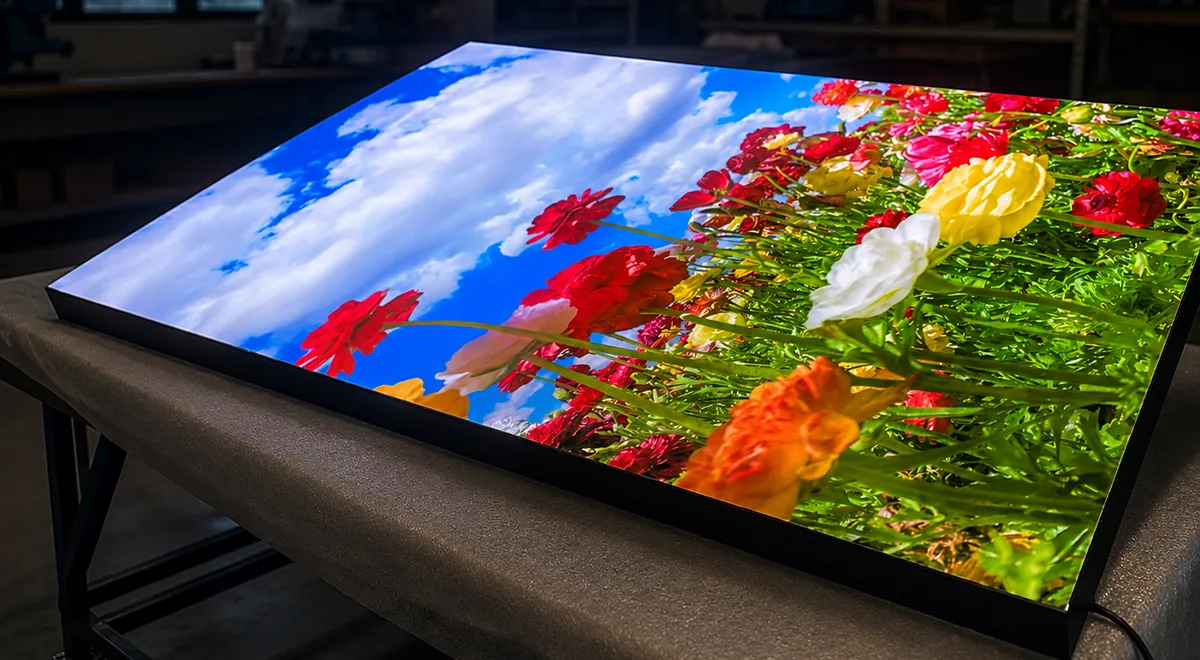
A light box sign is the quietest hard worker in signage. No moving parts, no drama — just an even glow that carries a brand day and night, from a shopfront, a wall, or a pole.
But the term covers everything from a cheap flat panel that yellows in a season to a thermoformed, double-sided piece that still looks new a decade later. The gap between them is invisible on the quote and obvious on the wall.
This guide explains the types, what decides how long one lasts, and how to choose the version that earns its place rather than embarrassing the brand.
What a light box sign is
A light box sign is an illuminated enclosure: a fabricated frame, a light source inside, and a translucent face that the light shines through. Switch it on and the whole face glows evenly, carrying the logo or message.
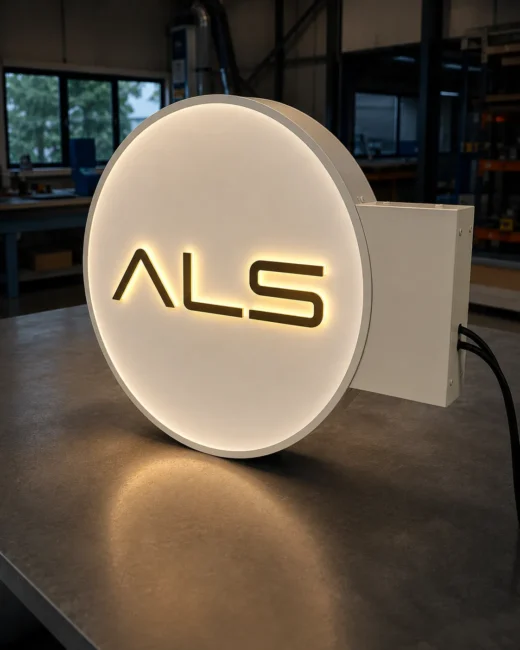
The format takes a few shapes. A flat panel light box mounts flush against a wall or fascia. A projecting (or blade) light box sticks out perpendicular to the wall, so it is read by people walking along the street, not just those standing in front of it. And it can be single-sided, showing one face, or double-sided, glowing from both directions at once.
That last distinction — how the box is mounted and how many faces it lights — is the first decision, because it changes everything about where the sign works.
Where light box signs work best
Light boxes earn their cost wherever a brand needs to be legible after dark and read from a distance.
On a shopfront fascia, a flat light box carries the primary identity, lit and clear at night when unlit signs vanish. As a projecting blade sign, it catches foot traffic coming from either direction along a busy street or mall walkway. Freestanding on a pole or plinth, it works as a forecourt or entrance marker. And indoors, a light box behind a reception desk turns a logo into a focal point the moment someone walks in.
Retail and hospitality lean on them heavily, for the same reason: an even, lit surface reads as professional and permanent in a way a printed panel never quite does.
Single-sided vs double-sided
The choice is dictated by how people approach the sign.
A single-sided light box is right when the sign is seen from one direction only — flat against a wall or fascia, where there is no “behind” to light. It uses less material and less power.
A double-sided light box lights both faces, and it is the correct choice for any projecting or blade sign. Mounted perpendicular to a wall, a projecting sign is read by people walking toward it from both directions. Light only one face and you are invisible to half the street. This is exactly the configuration in much of our own projecting work: two glowing faces on one mount, so the brand is seen coming and going.
Add a thermoformed domed face to a build like that and you get a piece that reads as a single sculpted object from either direction, not a flat panel bolted to a bracket.
The rule is simple. If someone can approach the sign from more than one side, it should be double-sided.
Flat face vs thermoformed (domed) face
This is where light box signs quietly separate into two tiers, and where most buyers do not know there is a choice.
A flat-face light box uses a flat sheet of acrylic, with the graphic printed or applied as vinyl. It is the standard, and it is fine for many jobs.
A thermoformed light box uses a face that has been heated and formed into a smooth, convex dome. The difference is not just cosmetic. The curved face diffuses the internal light more evenly, catches highlights along its surface, and reads as a single seamless object rather than a printed sheet in a frame.
It looks moulded, deliberate, premium — because it is. The trade-off is that thermoforming requires the capability and the tooling to form acrylic properly, which is why not every “manufacturer” offers it.
Acrylic behaves in specific ways under heat, and forming it cleanly is a skill; material producers such as Evonik PLEXIGLAS document how the sheet performs when thermoformed, and a real fabricator works to that.
When a brand wants its light box to look considered rather than commodity, the thermoformed face is the upgrade that shows.
What’s inside decides the lifespan
Two light boxes can look identical the day they are installed. A year later, one still glows evenly and the other has dark patches and a yellowing face. The difference is inside.
The LED modules decide the light. Cheap modules produce uneven illumination — bright near the diodes, dim between them — and fail one at a time, leaving dark spots across the face. We build with Baltled, SloanLED, and Principal LED modules, laid out for even coverage and long, colour-stable life. The frame decides the durability: an aluminium enclosure holds its shape and resists weather where cheaper materials warp or corrode. And the face decides the look over time: quality acrylic stays clear and white, while low-grade material yellows under UV.
None of this is visible in a photo of a new sign. It is visible in year three. That is why, with light boxes, the build matters more than the price.
How light box signs are made
A good light box is a fabrication job, not an assembly of bought-in parts. The chain runs in steps. Build the aluminium frame. Cut or thermoform the acrylic face. Lay out and wire the LED modules for even light. Then assemble, seal, and finish the enclosure.
Owning that chain in-house is what lets a manufacturer control quality at every step. It also means taking on the non-standard job: the odd shape, the domed face, the double-sided projecting build.
At VIZAL, the whole process runs under one roof, backed by 25 years of production. You can see how it fits together in our signage manufacturing process. A supplier that buys in finished boxes controls none of it.
Light box vs channel letters vs acrylic signs
These three get confused, so here is the clean distinction.
A light box sign carries the whole message on a single lit face — best when you want a bright, even surface and a lot of legibility for the money.
Channel letters are individual three-dimensional letters, each lit on its own, for a more premium, dimensional look; the full picture is in our channel letters guide. Acrylic signs are typically flat, often non-illuminated panels or letters, covered in our guide to acrylic signs.
Choosing between them comes down to budget, the look you want, and where the sign sits. A light box gives maximum lit surface per euro; channel letters give dimensional prestige; flat acrylic gives clean, economical branding. Many storefronts use more than one, which is the logic behind treating them as one coordinated retail signage system rather than separate purchases.
Frequently asked questions
What is a light box sign?
An illuminated sign made of a fabricated frame, an internal light source, and a translucent face that the light shines through, so the whole face glows evenly. It can be flat or projecting, single or double-sided, and is used on shopfronts, blade signs, and reception walls.
Single-sided or double-sided light box? Single-sided when the sign is seen from one direction, such as flat against a wall. Double-sided for any projecting or blade sign, so it is legible to people approaching from both directions along a street.
What is a thermoformed light box, and is it worth it? A thermoformed light box has a face heated and formed into a smooth convex dome, rather than a flat sheet. It diffuses light more evenly and reads as a premium, seamless object. It costs more because it needs real forming capability, and it is worth it when appearance matters.
How long do light boxes last? With quality LED modules, an aluminium frame, and good acrylic, many years of even, trouble-free light. Cheap builds fail far sooner, with dead diodes, dark patches, and a yellowing face. Lifespan is decided by the components, not the first-day look.
Conclusion: buy the build, not the box
Every light box glows on day one. The question is what it looks like on day one thousand. Four things decide that: the frame, the LED layout, the grade of acrylic, and the face. Is it a flat sheet, or a properly thermoformed dome? That choice decides whether the sign keeps selling the brand or starts undermining it.
So ask what is inside. Ask who makes it. And favour a fabricator that forms and builds in-house, not one boxing up imported parts.
VIZAL manufactures light box signs in-house: flat and thermoformed, single and double-sided. Everything is factory-direct in the EU, white-label, with 25 years of production behind it. See the work in our portfolio. Then tell us what you need. We will come back with a light box built to still look new years from now.