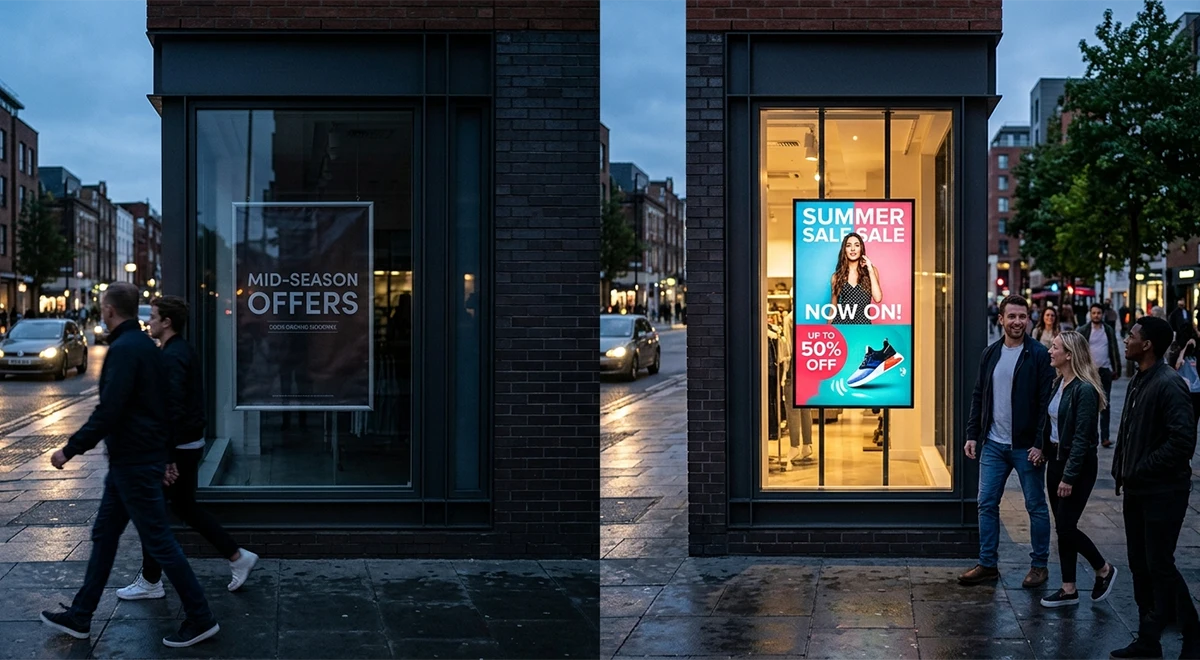
You’ve set up the interior. The product is solid. The team is ready. But if customers can’t see you clearly — from the street, in the lobby, at the point of sale — none of that matters. That’s the problem an LCD screen solves.
Not in a flashy, trend-chasing way. In a direct, measurable way: it puts your content exactly where people are looking, at the moment they decide whether to walk in, engage, or buy.
In this article, we break down what an LCD screen actually is, what types exist, where each one performs best, and what to look for when choosing a supplier. If you’re a business owner, retail chain, or brand manager thinking about visual communication — this is the practical guide you need.
What Is an LCD Screen, and Why Does It Matter for Business?
An LCD screen (Liquid Crystal Display) is a flat-panel display technology that uses liquid crystals and a backlight to produce images, text, and video. It’s the same technology found in most monitors, televisions, and digital signage panels worldwide.
For businesses, an LCD screen isn’t a decoration. It’s a communication tool.
It replaces static printed materials with dynamic content that can be updated in real time. A promotion running today looks different from tomorrow’s campaign. A menu item sells out — it disappears from the screen immediately. A waiting room plays branded content instead of silence.
The shift from static to dynamic is significant. Studies on digital signage effectiveness consistently show that digital displays attract 400% more views than static print, and recall rates for digital content are substantially higher.
LCD screens are at the core of modern LED display solutions used across retail, hospitality, corporate environments, and public spaces.
Types of LCD Screen Used in Business Signage
Not all LCD screens are the same. The environment, viewing distance, ambient light, and content type determine which format is right for your situation.
Window LCD Displays
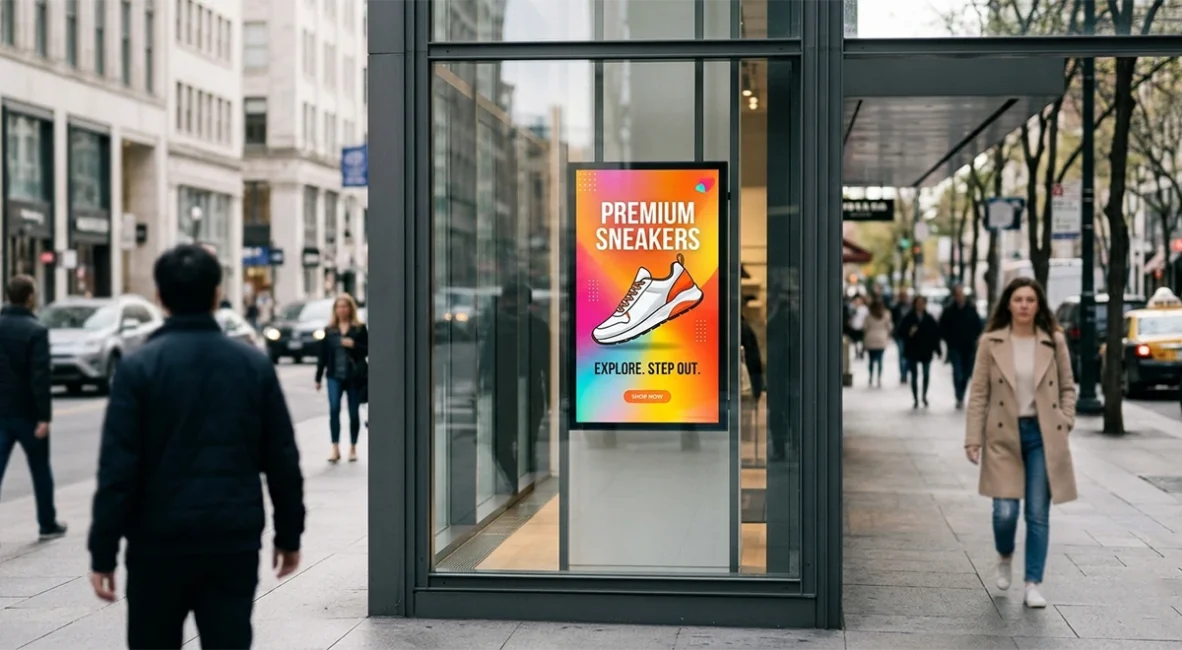
Positioned in storefront windows, these screens are designed for high-brightness output — readable in direct sunlight. They communicate to people outside before they’ve made the decision to enter.
This is where foot traffic decisions happen. If your window display is a printed poster that hasn’t changed in three weeks, you’re losing the moment.
Window LED solutions by VIZAL are built specifically for this context: maximum brightness, weatherproof enclosures, and content that can be updated remotely.
Wall-Mounted LCD Screens
Used in lobbies, showrooms, restaurants, clinics, and corporate environments. Wall-mounted screens are designed for indoor viewing, with a focus on image quality, color accuracy, and seamless integration with the space’s architecture.
These aren’t television sets bolted to a wall. A properly specified wall LED solution is engineered for continuous operation, content management integration, and dimensional compatibility with the installation space.
Freestanding LCD Displays
Also called stand-alone displays, these are used in retail floors, trade show environments, event spaces, and brand activations. They don’t require permanent installation, which makes them versatile for seasonal campaigns or temporary setups.
Stand-alone LED display solutions from VIZAL are designed for mobility without compromising on build quality.
Desk and Counter LCD Screens
Compact displays positioned at countertops, reception desks, and point-of-sale areas. This is close-range communication — the customer is directly in front of you. The screen shows offers, loyalty program details, current promotions, or directional content.
Desk LED solutions are small in size but significant in impact. At the moment of decision, a well-placed display with the right message can directly influence what the customer does next.
Where LCD Screen Deliver Real Business Results
Retail
Product promotion, seasonal campaigns, flash discounts, cross-selling at checkout. Retail environments are high-traffic, high-distraction spaces. An LCD screen cuts through that noise with moving content that customers actually stop and read.
A retail chain that updates its window display content twice a week looks and feels like a business that’s active, relevant, and worth entering.
HoReCa (Hotels, Restaurants, Cafés)
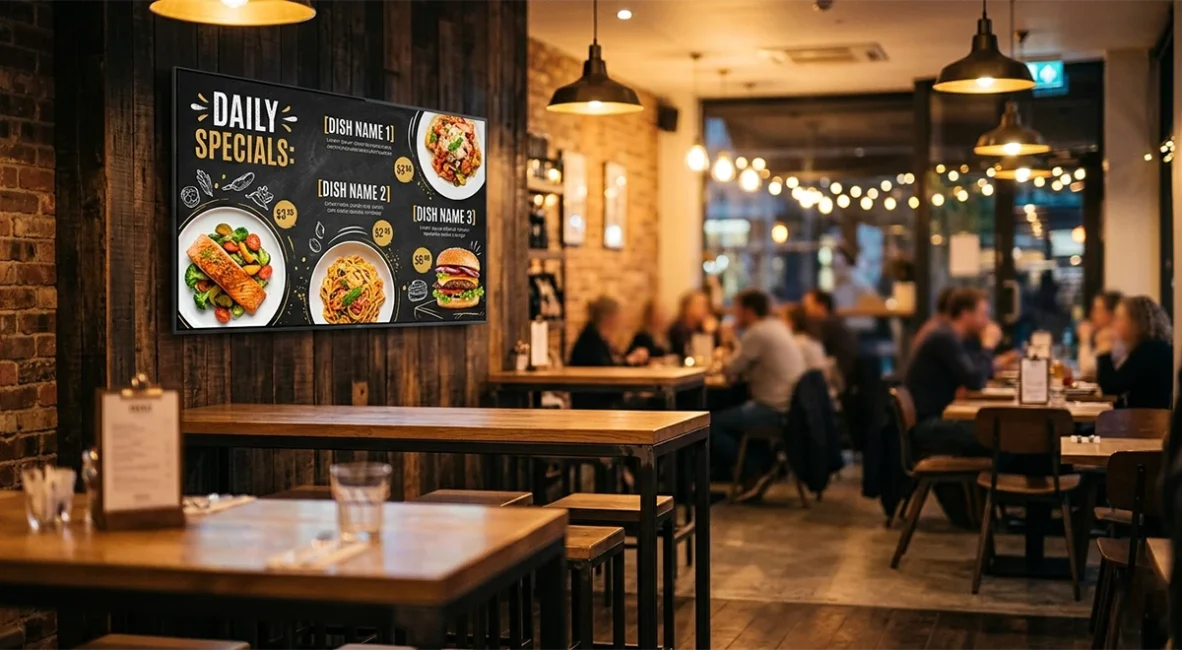
Menus that update in real time. Specials that change daily. Branded content in waiting areas that reinforces the atmosphere. LCD screens in HoReCa environments are not an upgrade — they’re an expectation in competitive markets.
At Restaurantele OK, VIZAL delivered tailored signage solutions built around exactly this need: involvement, fast communication, and creative consistency across locations.
Medical and Clinic Environments
Waiting areas with patient information, health tips, and facility navigation. At Medikali, VIZAL produced signage that built trust through professional presentation — because in healthcare, visual credibility directly affects how patients perceive care quality.
See the Medikali project in our portfolio.
Corporate and Office Environments
Lobby branding, meeting room directories, internal communication displays. A corporate space with digital signage communicates organizational maturity. It signals to visitors, clients, and employees that the company operates at a professional level.
Cinema and Entertainment
At Movieplex, VIZAL installed LED display solutions designed to promote films, events, and offers at high visibility in a busy environment. Dynamic content in entertainment venues is a direct driver of impulse decisions.
See the Movieplex LED display project.
What to Look for When Choosing an LCD Screen for Your Business
This is where most businesses get it wrong. They focus on screen size and price. That’s the wrong order of thinking.
Start with the environment.
Indoor or outdoor? Direct sunlight exposure? Viewing distance? Ambient temperature range? A screen that performs beautifully in a controlled lobby may fail completely in a south-facing storefront.
Then specify the content requirements.
Static images only, or video? Real-time data integration? Remote content management? The answer determines the processing power, connectivity, and software your installation needs.
Then consider operational demands.
A display running 8 hours a day in a retail store has different durability requirements than one running 24/7 in a transit hub. Specify operating hours, ventilation requirements, and maintenance access before selecting hardware.
Finally, evaluate the supplier.
An LCD screen is not a commodity purchase. Installation, calibration, content management setup, and ongoing support are part of what you’re buying. A supplier who delivers hardware and disappears has sold you half a solution.
VIZAL has been producing and supplying LCD display solutions for over 20 years. We work directly as manufacturer — no intermediaries, manufacturer pricing, and a team that handles production, delivery, and installation. Clients like CAZICOM have worked with us for over a decade precisely because of this: consistent quality, fast responses, and accountability after the sale.
LCD Screen vs. Other Display Technologies: A Practical Comparison
| Feature | LCD Screen | LED Matrix | Static Print |
|---|---|---|---|
| Content flexibility | High — updateable in real time | High — updateable in real time | None |
| Image quality | Excellent — sharp, accurate color | Good — pixel pitch dependent | Static |
| Indoor use | Optimal | Good | Yes |
| Outdoor / high brightness | Requires high-brightness spec | Excellent | Fades over time |
| Operating cost | Low | Low | Recurring print costs |
| Initial investment | Medium | Medium-High | Low |
| Content management | Yes | Yes | Manual replacement |
For most indoor environments — retail, corporate, HoReCa, medical — an LCD screen delivers the best balance of image quality, cost, and operational simplicity.
For large-scale outdoor advertising or environments requiring viewing distances above 5–6 meters, LED matrix displays may be more appropriate. VIZAL produces both — and will specify the right technology for your situation, not the one with the higher margin.
How VIZAL Approaches LCD Screen Projects
Every display installation starts with a conversation about the environment, the content, and the business objective. We don’t sell screens — we design communication systems.
The process:
- Site assessment — dimensions, ambient light, viewing angles, installation constraints
- Technology specification — screen type, brightness, resolution, enclosure requirements
- Content management setup — software configuration, remote access, training if needed
- Production and installation — handled directly by our team
- Ongoing support — we remain accountable after delivery
This is what “manufacturer pricing” actually means at VIZAL: direct production, no layers, and full responsibility from specification to operation.
Frequently Asked Questions
How much does an LCD screen for business signage cost?
It depends on size, brightness specification, enclosure type, and whether content management software is included. A desk or counter display starts at a different price point than a high-brightness window display or a multi-screen wall installation. Contact VIZAL directly for a specification-based quote — generic prices online rarely reflect what you actually need.
What’s the difference between an LCD screen and an LED display?
An LCD screen uses a liquid crystal panel with a separate backlight — typically LED. What the industry calls an “LED display” usually refers to LED matrix or LED pixel displays, where each pixel is an independent light source. LCD screens generally offer better color accuracy and are more cost-effective for indoor use. LED matrix displays perform better at large scale and outdoor settings. For indoor business applications, LCD is almost always the right starting point.
How long do LCD screens last in a commercial setting?
Commercial-grade LCD panels are rated for 50,000–100,000 hours of operation, depending on specification and usage pattern. At 12 hours per day of operation, that’s over 10 years. The critical variable is whether the screen is rated for commercial continuous use — consumer televisions are not, and they fail significantly faster in business environments.
Can the content be updated remotely?
Yes. Modern LCD display systems include content management software that allows remote updates — by location, by schedule, or in real time. This is standard in any properly specified business display solution.
The Bottom Line
An LCD screen is not a technology purchase. It’s a decision about how your business communicates with the people who are already in front of it.
Every customer who walks past your window, enters your lobby, or stands at your counter is a moment. A static sign is a fixed message. An LCD screen is a live conversation.
If you’re ready to specify the right display solution for your environment, contact VIZAL for a direct consultation. We’ll assess your space, specify the right technology, and deliver it at manufacturer pricing — with the same accountability we’ve maintained with clients across retail, HoReCa, medical, and corporate sectors for over 20 years.
View our LED display solutions or explore our portfolio to see how we’ve approached similar projects.