

Most businesses choose their signage manufacturers once and live with the consequences for years.
That means the decision of which signage manufacturer you work with is not a minor procurement call — it determines how your brand is perceived every day, by every person who walks past your location.
There are hundreds of signage manufacturers across Europe. They all claim quality. They all promise fast delivery. And most of them will hand you something that looks fine on screen but loses its edge within 18 months of real-world exposure.
This article breaks down what professional signage manufacturing actually involves, what to demand from any manufacturer before you sign off on a project, and why the gap between average and excellent in this industry is wider than most buyers realize.
What Signage Manufacturers Actually Do (and What Many Skip)
The word “manufacturer” implies the full chain: design, engineering, production, and installation. In practice, many signage suppliers outsource large portions of this process — especially the more complex parts — and act more as coordinators than producers.
What a genuine signage manufacturer controls in-house:
- 3D design and technical engineering — not just a visual mockup, but a structurally sound product designed for real mounting conditions
- CNC routing, laser cutting, and sheet metal fabrication — precision production from aluminum, acrylic, aluminum composite, and steel
- LED integration and light distribution — correct module selection, spacing, and thermal management to avoid hot spots and premature degradation
- Surface finishing — painting, powder coating, satin finishing, and quality control before anything leaves the facility
- Installation — teams who understand both the structural and electrical requirements on-site
If a manufacturer hands off fabrication to a third party or doesn’t have the equipment to show you, you’re paying for coordination, not manufacturing.
The 5 Standards That Define a Reliable Signage Manufacturer
1. In-House Production Capability
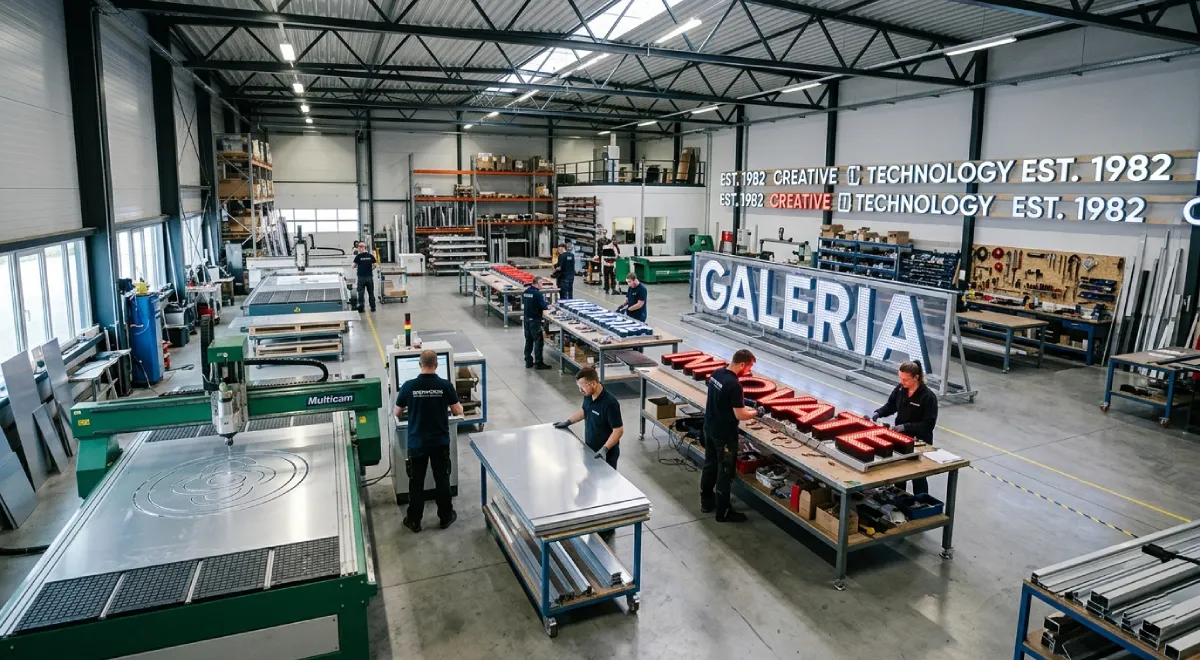
The clearest indicator of manufacturing quality is what happens inside the facility. Visit if you can. Ask for photos. A serious manufacturer will have CNC machines, bending equipment, welding stations, and a paint booth — not just a design studio and a phone.
Vizal operates a full production facility in Râmnicu Vâlcea, with over 25 years of manufacturing experience and a team of more than 25 specialists. Every project — from illuminated 3D letters to steel totems — is designed, engineered, and produced under one roof.
2. LED Expertise That Goes Beyond Substitution
LEDs are not interchangeable. Light distribution, color consistency, IP rating, and heat dissipation all affect how a sign performs after three years of outdoor exposure. Signage manufacturers who treat LEDs as a commodity rather than an engineering variable tend to produce signs that look identical at delivery and unrecognizable 24 months later.
Professional manufacturers specify modules based on the sign type, installation environment, and the desired output. The difference between frontlit and backlit (halo) illumination, for example, is not just aesthetic — it determines which modules are appropriate, how they’re spaced, and how the return profile is built.
3. Structural Engineering, Not Just Aesthetics
A sign installed on a facade at 8 meters height in a Central European winter needs to be engineered, not just designed. That means accounting for wind load, thermal expansion, substrate anchoring, and weatherproofing.
Manufacturers who work from 3D models — not just flat artwork — produce signs that behave predictably under real conditions. This applies equally to light boxes, LED totems, and complex indoor 3D letter installations.
4. A Portfolio That Matches Your Sector
Different sectors have different requirements. Retail signage prioritizes visibility and brand consistency across multiple locations. Medical and professional services require restraint, precision, and material durability. HoReCa demands atmosphere, often combining LED neon flex with architectural elements.
Ask to see work from your sector specifically. A manufacturer with a strong HoReCa portfolio may not have the experience to handle a multi-site retail rollout — and vice versa.
Vizal has delivered projects for clients including Teilor, DAAR, Annabella, The Marmorosch Hotel, Medikali, MG Motors, and Euro Market — covering retail, luxury, hospitality, medical, and automotive. The full portfolio is available here.
5. Transparent Communication and Realistic Timelines
The businesses that get burned by signage manufacturers almost always describe the same experience: the quote was fast, the communication disappeared during production, and the installation was late or incomplete.
A professional manufacturer gives you a production timeline before you commit, updates you at key stages, and has a clear process for handling revisions. These aren’t nice-to-haves — they’re operational indicators of how the company is run.
Channel Letters: The Product That Reveals a Manufacturer’s Real Capability
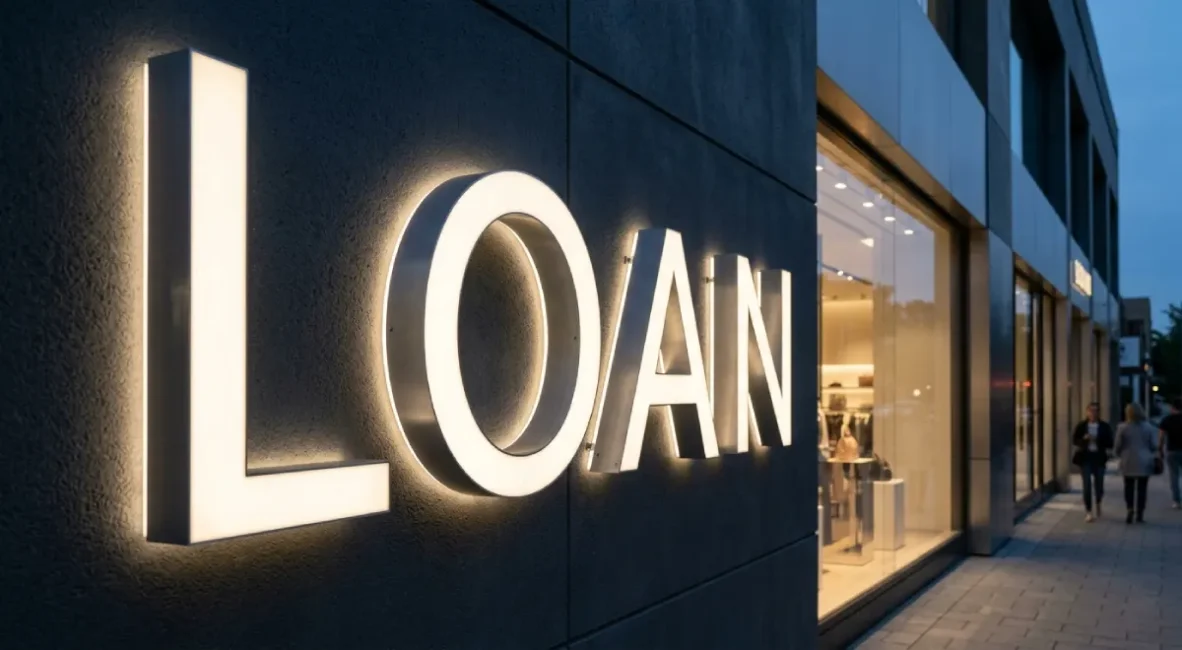
If you want to evaluate a signage manufacturer quickly, ask about their channel letter production.
Channel letters are individually fabricated illuminated letters mounted directly to a facade or raceway. They require precision at every stage: the face must be cut accurately, the return depth must be consistent, the trim cap must be seated cleanly, the LED modules must be installed with correct CC distance, and the wiring must be weather-sealed before the letter is closed.
It’s the kind of product that exposes shortcuts immediately — in the uniformity of illumination, the consistency of letter spacing, the finish quality of the returns, and the behavior after six months outdoors.
Manufacturers who produce clean channel letter work have the equipment, the process control, and the attention to detail that carry over into everything else they make.
What European Clients Should Know When Working with Signage Manufacturers
The European signage market is not uniform. Standards for electrical components, installation permits, and material specifications vary by country. Manufacturers who work internationally need to be familiar with these differences — not just capable of shipping a product across a border.
Key questions for any manufacturer you’re considering for cross-border projects:
- Do you handle export documentation and compliance for the destination country?
- Are your electrical components CE certified?
- Do you have installation partners in the target market, or do you expect the client to manage on-site execution?
- Can you provide technical drawings in formats required for local permitting?
Vizal has supplied clients and agency partners across Europe, operating with factory prices, a 2-year guarantee, and direct coordination on production and delivery logistics.
Signage Manufacturers vs. Signage Resellers: Why the Difference Matters
Many companies position themselves as signage manufacturers when they are, in practice, resellers — sourcing from third-party factories and adding a margin without adding manufacturing value.
This matters for three reasons:
Price: A reseller’s quote includes their margin over the actual production cost. For large-format projects or multi-location rollouts, this difference is significant.
Control: When problems arise during production — and they will — a reseller has limited leverage over the factory. A manufacturer can intervene directly.
Customization: Off-the-shelf products from a reseller’s catalog don’t accommodate non-standard dimensions, unusual substrates, or client-specific engineering requirements. A real manufacturer can.
The test is simple: ask for a facility tour, ask who builds the product, and ask to meet the production team. Resellers can’t answer these questions convincingly.
Comparing Signage Product Types by Application
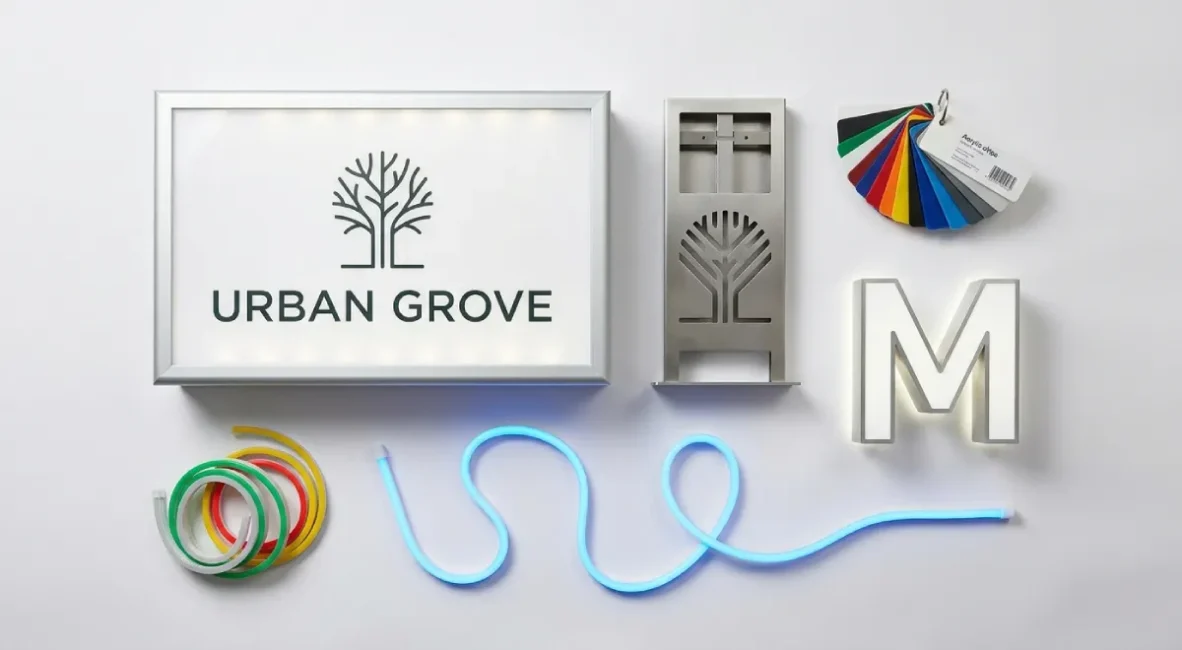
| Product Type | Best For | Illumination Options | Typical Lifespan |
|---|---|---|---|
| Channel Letters | Retail facades, storefronts | Frontlit, backlit (halo), side-lit | 7–10 years |
| Light Boxes | Interior/exterior advertising | LED panel, perimeter LED | 8–12 years |
| Steel Totems | Parking, campus, hotel forecourt | Frontlit, internal LED | 10–15 years |
| LED Neon Flex | Interiors, HoReCa, events | RGB, single color | 5–8 years |
| LED Displays | Digital content, high-traffic areas | Full matrix, transparent | 5–10 years |
FAQ: Signage Manufacturers
How do I verify that a signage manufacturer actually manufactures?
Ask for a facility visit or a video walkthrough of their production floor. A genuine manufacturer will have CNC routing equipment, bending machinery, a spray booth, and an assembly area. Request references from past clients and check whether the timelines and quality described match what the manufacturer claims.
What is a realistic production timeline for custom signage?
For straightforward channel letters or light boxes, expect 2–4 weeks from approved design to production completion, plus installation time. Complex projects involving structural totems, multi-location rollouts, or non-standard materials may require 6–10 weeks. Any manufacturer quoting significantly shorter times for complex work without explanation warrants scrutiny.
Does working with a manufacturer in Romania affect quality or logistics for Western European clients?
Not if the manufacturer has documented experience with export projects, CE-certified components, and established logistics partnerships. Production costs in Romania are competitive relative to Western Europe, and a fully equipped facility can match or exceed the output quality of higher-cost markets. The key variable is the manufacturer’s specific capability — not the geography.
What guarantee should I expect from a professional signage manufacturer?
A 2-year guarantee on materials and workmanship is standard for quality manufacturers. This should cover LED module performance, structural integrity, and surface finish. Clarify what the guarantee covers in writing before placing an order.
Conclusion
Your signage is not decoration. It is the first thing a potential customer sees before they decide whether to enter, inquire, or walk past.
The signage manufacturer you choose determines whether that first impression works for your business or against it — not just at installation, but for the next decade.
Vizal has been producing custom signage for over 25 years, with a full in-house production facility, a portfolio across retail, hospitality, medical, and corporate sectors, and direct experience supplying clients across Europe.
If you’re evaluating signage manufacturers for a current or upcoming project, contact Vizal for a quote or explore the portfolio to see what professional manufacturing looks like in practice.