
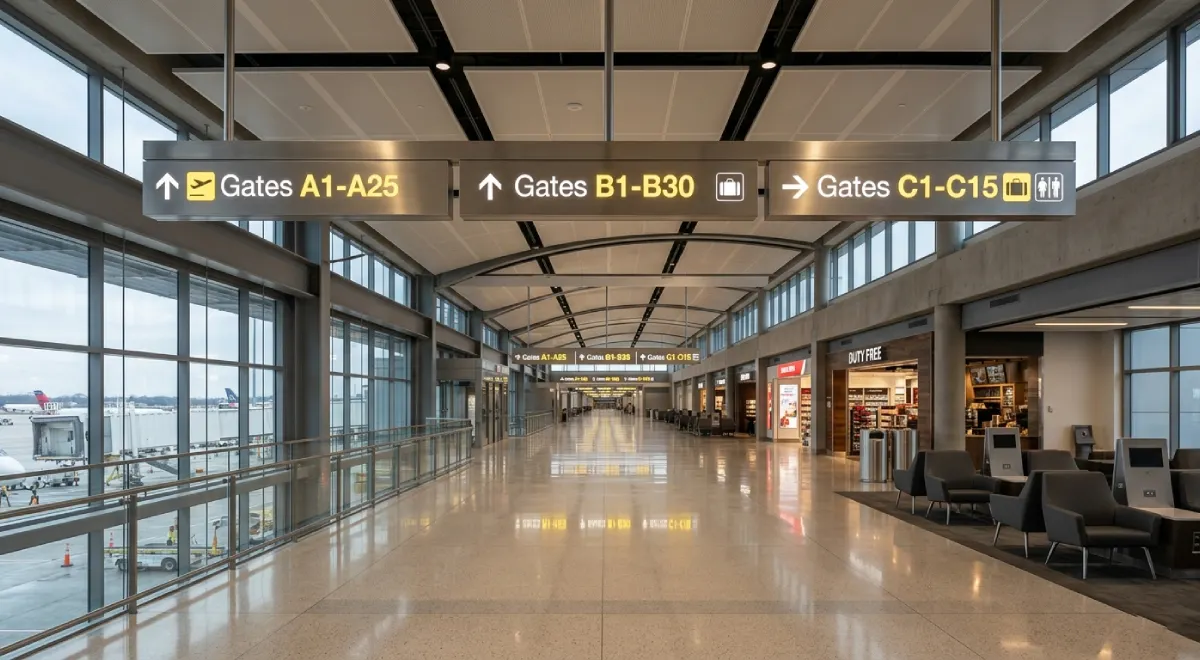
Every year, airports move hundreds of millions of passengers through complex, high-pressure environments. People are stressed, distracted, often in an unfamiliar terminal, running against a clock.
If they can’t find the gate, the lounge, or the exit — that’s not a passenger problem. That’s a signage problem.
Airport wayfinding is one of the most demanding categories in commercial signage. It needs to perform under pressure, across multiple languages, for people with different visual abilities, in spaces that never stop moving. Done right, it’s invisible — passengers flow through the terminal without thinking about it. Done wrong, every confused face at a junction is a failure of the system.
In this guide, we’ll therefore break down what professional airport wayfinding signage actually involves. First, we’ll cover what separates functional systems from failing ones. Then — and most importantly — we’ll show how custom manufacturing makes the difference between a system that guides and one that just decorates.
What Airport Wayfinding Actually Means
Wayfinding is not signage decoration. It’s a navigation system.
The goal is simple: move people from point A to point B with zero confusion and minimum cognitive load. In an airport context, that means managing dozens of simultaneous journeys — departures, arrivals, transfers, retail, services — across a space that can span hundreds of thousands of square meters.
A professional wayfinding signage system for an airport includes:
- Directional signs — suspended or wall-mounted, showing routes to gates, exits, baggage claim, check-in
- Identification signs — marking specific locations: gates, lounges, restrooms, service areas
- Informational signs — terminal maps, transport connections, emergency procedures
- Regulatory signs — security zones, restricted areas, safety compliance
Each category serves a different moment in the passenger journey. Each must be legible, consistent, and positioned exactly where a person’s gaze falls when they need to make a decision — not three steps after.
Why Airport Environments Are Different from Standard Commercial Spaces
Most commercial wayfinding operates in predictable environments: an office building, a hospital corridor, a retail complex. Airports compress all of that complexity and add three layers that make everything harder.
Volume and speed. A busy international airport handles 50,000+ passengers per day. Signs aren’t read — they’re scanned at walking speed, often mid-conversation, mid-stress. Messaging must be immediate. Typography and contrast must eliminate ambiguity.
Spatial complexity. Terminals expand over time. Gates get renumbered. Retail concessions shift. A wayfinding system that can’t adapt to physical changes becomes a liability. This is why modular, updatable sign systems matter — not single-use fabrications.
Regulatory and accessibility compliance. Aviation environments operate under strict standards for signage height, placement, illumination levels, and accessibility (ADA, EN standards, ICAO guidelines). Custom signage needs to meet these requirements by design, not as an afterthought.
Brand environment. Airports are increasingly brand environments. Terminals like Changi in Singapore or Heathrow’s Terminal 5 are architectural statements. Wayfinding signage must integrate with the overall aesthetic — custom profiles, premium materials, controlled illumination — rather than fighting against it.
The Components of a High-Performance Airport Wayfinding System
Suspended Directional Panels
These are the workhorses of airport navigation. Hanging from ceiling structures at key decision points — junctions, escalator landings, entry points — they need to be legible from 20+ meters, in both directions of travel.
Professional execution requires precision fabrication: aluminum extrusion frames with concealed fastening, matte or anti-glare face materials, integrated LED backlighting with even distribution and no hotspots. The difference between a panel that reads clearly at 25 meters and one that doesn’t is in the manufacturing — tolerances, surface finish, luminous uniformity.
Floor-Level and Column Signage
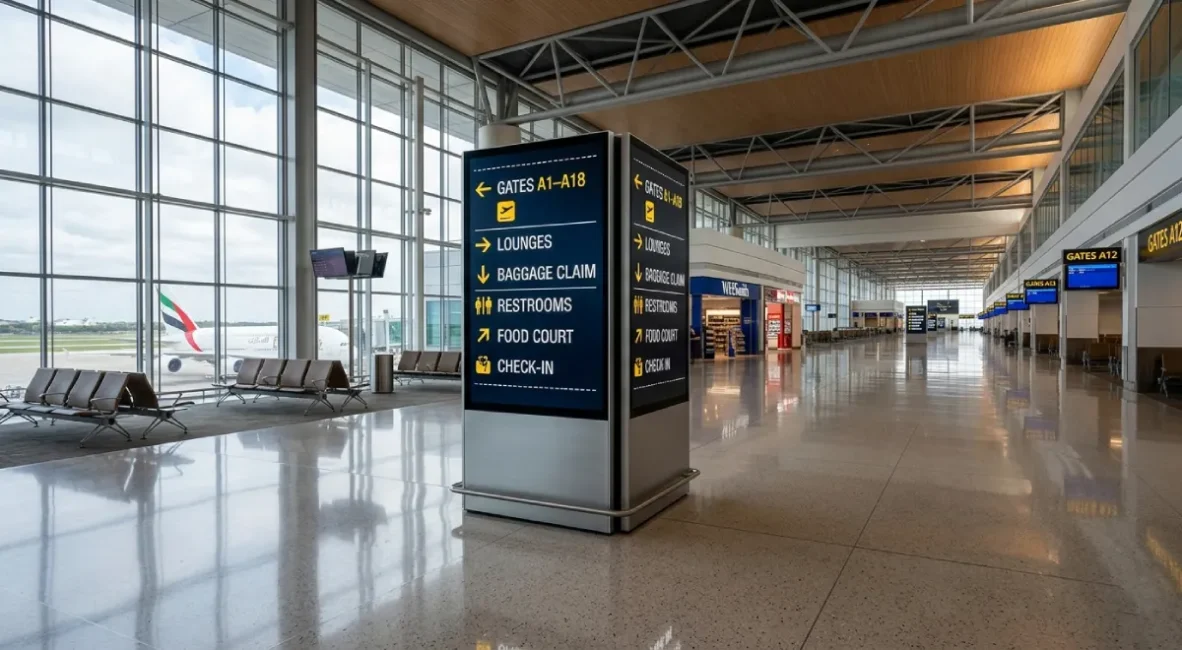
Not all passengers look up. Experienced airports layer their navigation systems across multiple eye levels. Column wraps, floor-mounted totems, and wall-applied directional markers work together to create a redundant system. In other words, if you miss the overhead sign, the next layer will catch you.
Steel totems adapted for interior use are increasingly common in large terminals — freestanding, double-sided, illuminated, and repositionable as layouts change.
Gate and Zone Identification
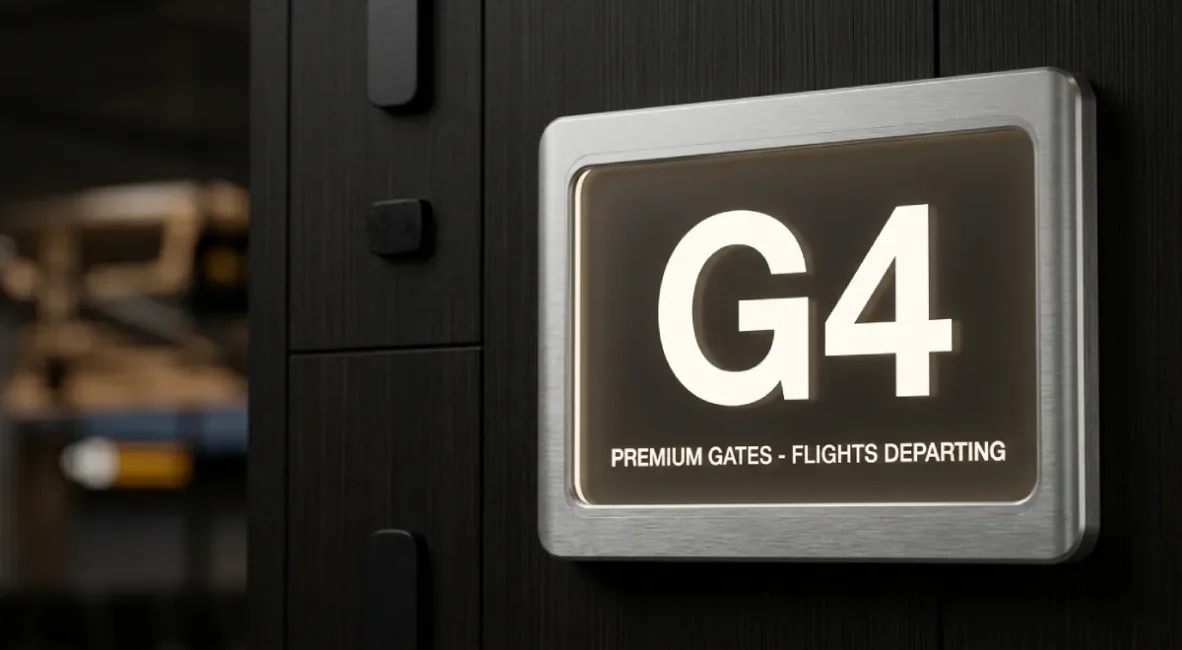
At the gate level, identification signage shifts from directional to confirmatory. The passenger who has followed directions now needs to verify they’ve arrived correctly. Gate markers, zone indicators, and lounge entrance signs serve this function.
Here, detail matters more than scale. Premium materials — brushed aluminum, backlit acrylic, custom color-matched finishes — reinforce the brand experience at the point of destination. A well-executed gate sign does two things simultaneously: it confirms the location and it communicates quality.
Emergency and Regulatory Signage
These aren’t optional. They’re specified by law and by aviation safety authorities. Professional signage manufacturers work to these standards by default — illuminated emergency exit indicators, photoluminescent strips, clearly demarcated security boundaries.
Integrating regulatory signage into a coherent visual system requires planning from the start. It cannot be bolted on at the end.
Materials and Manufacturing: What Separates Good Wayfinding from Great Wayfinding
The difference between signage that lasts 18 months and signage that performs for 10 years is in the manufacturing.
Airports are harsh environments. Continuous foot traffic creates vibration. Climate control systems create temperature differentials. Cleaning regimes involve chemicals that degrade cheaper materials. High-volume public spaces mean physical contact with signage is constant.
Aluminum profiles — extruded, powder-coated, or anodized — are the professional standard for structural components. They’re dimensionally stable, corrosion-resistant, and capable of precision fabrication for tight tolerances.
Acrylic and polycarbonate faces — used for illuminated panels — need to be UV-stable, impact-resistant, and consistent in light transmission. Off-the-shelf materials vary significantly in quality. Custom specification matters.
LED illumination — the standard for all illuminated wayfinding — needs to be chosen for color consistency (CRI 90+), long service life (50,000+ hours), and uniform output. Modules from professional-grade suppliers like those used in commercial signage production ensure performance matches specification.
Surface finishes — brushed, satin, mirror, powder-coat — must be specified for durability in high-touch environments, not just aesthetics.
Custom fabrication means these decisions are made deliberately, for the specific environment, not defaulted to whatever is cheapest or fastest.
Wayfinding as Brand Infrastructure
There’s a commercial case for taking airport wayfinding seriously that goes beyond passenger convenience.
Dwell time and retail revenue. Airports generate significant revenue from retail and F&B. Passengers who navigate confidently reach retail zones with time to spare. Passengers who are confused spend that time looking for gates. Clear wayfinding is directly linked to retail performance — this is documented in airport commercial strategy.
Brand perception. The terminal is the first and last physical touchpoint of the travel experience for most passengers. A disorganized, visually inconsistent wayfinding environment communicates one thing: this space wasn’t designed with you in mind. Premium, coherent wayfinding communicates the opposite.
Operational efficiency. Confused passengers create queues. Queues at decision points create congestion. Congestion affects gate boarding, aircraft turnaround, and on-time performance. Wayfinding is an operational tool, not just an aesthetic one.
For airport operators and the agencies that design terminal environments, these arguments are well-understood. The challenge is execution — finding manufacturers who can deliver at the required standard, within schedule, and to exact specification.
What to Look for in an Airport Wayfinding Signage Manufacturer
Not every signage supplier is equipped for airport-scale projects. The requirements are specific.
Custom fabrication capability. Airport wayfinding almost never fits standard product lines. Ceiling heights, structural attachment points, terminal aesthetics — everything requires custom-engineered solutions. A manufacturer without sheet metal fabrication, custom extrusion, and CNC capability cannot deliver this.
Material expertise. Working with aluminum, stainless steel, acrylic, and composite materials to specification requires both equipment and experience. Ask to see examples of executed projects, not just renderings.
LED specification knowledge. Illuminated wayfinding is only as good as its light source. A manufacturer who specifies professional-grade LED modules — and can demonstrate luminous uniformity and color consistency — is a different proposition from one who sources generic components.
Project management. Large-scale wayfinding is a coordinated installation, not a product delivery. Phased installation around live terminal operations, coordination with structural teams, adherence to aviation authority requirements — this is project management capability, not just manufacturing.
Track record. The Marmorosch hotel wayfinding project — custom brass navigation signs integrated into a historic architectural environment — demonstrates what precision custom signage can achieve in a demanding hospitality context. The same manufacturing principles apply at airport scale.
The Airport Wayfinding Brief: What Information You Need to Get Started
Whether you’re an airport operator, an architecture firm, or a signage agency managing a terminal fit-out, a wayfinding project brief should cover:
- Terminal dimensions and layout — floor plans, ceiling heights, structural grid
- Passenger volume and flow data — peak hour movements, primary routes, decision points
- Brand standards — typeface, color palette, material specifications, tone
- Regulatory requirements — applicable standards (ADA, EN, local aviation authority)
- Installation constraints — live terminal operations, structural access limitations, timeline
- Maintenance expectations — update frequency, replacement access, long-term service
The cleaner the brief, the more accurately a manufacturer can specify materials, estimate production complexity, and commit to a delivery schedule.
FAQ: Airport Wayfinding Signage
How long does it take to produce and install a custom airport wayfinding system?
Production timelines depend on project scale and complexity. A complete terminal wayfinding system — from finalized design to installed signage — typically requires 8–20 weeks. This includes engineering and fabrication time, finish processing, quality control, and coordinated installation. Phased delivery is common for large terminals, allowing sections to be installed and commissioned while production continues.
What materials are most durable for high-traffic airport environments?
Aluminum profiles (extruded or sheet-formed) are the industry standard for structural components — dimensionally stable, corrosion-resistant, and compatible with all standard surface finishes. Faces for illuminated panels are typically acrylic or polycarbonate, specified for impact resistance and UV stability. Surface finishes should be specified for chemical resistance given standard cleaning regimes in public spaces.
Can wayfinding signage be updated or reconfigured after installation?
Yes — and this should be a design requirement from the start. Modular systems with replaceable face panels allow gate numbers, directional information, and zone identifiers to be updated without replacing the entire sign structure. This is standard practice in professional wayfinding design and significantly reduces the long-term cost of keeping navigation information current.
The Standard Is High. The Execution Has to Match.
An airport that moves 30,000 passengers a day cannot afford signage that almost works. The margin for ambiguity is zero. Passengers who miss flights, miss gates, or miss connections because navigation failed them don’t forget it.
Professional airport wayfinding is a system — designed, engineered, fabricated, and installed as a coherent whole. It requires manufacturers who can work to specification, in custom materials, at scale, with the project management capability to coordinate delivery into live operational environments.
So, where do you start? First, you need to define your requirements. Specifically, that means dimensions, standards, timeline, and brand. Only then can a manufacturer give you an accurate specification and a realistic delivery schedule.
Contact VIZAL to discuss your wayfinding project. Alternatively, you can explore completed wayfinding work in the VIZAL portfolio. For example, the premium brass wayfinding system delivered for The Marmorosch hotel in Bucharest shows exactly what’s possible at the highest level of execution.
For broader context on wayfinding design principles, see also our guide to wayfinding signage solutions for buildings, offices, and public spaces.